So high carb is the talk of the town right now. And as it’s intricately connected to our energy systems when exercising it is both a basic topic in the sense that a lot of it is derived from it and at the same time a very complex topic as it relates to so many different processes during and outside of exercise.
So it is already clear that this will be a kind of series where we try to dive deeper and deeper into the topic. That being said, I want to get the basics right. So in this article we shall have a look at why we actually need carbs for racing and training at our best and can not just rely on fat. And bear with me, while we start our diving journey we will have to be a little bit imprecise with words and concepts for now.
when a fire starts to burn
So obviously we need energy – not only for exercise but for mere existence as well. Exercise however cranks up our energy demands quite a bit. An easy jog might bump it up a little and method acting as a rocket on the track will be a considerable multiplicator. Where do we get this energy from? You are absolutely right if you mumbled fats and carbs in your marble. While our bodies can use proteins for energy production this is more of a last resort method that we actually do not want to rely on. This leaves us with the aforementioned fats and carbs as our main energy sources (substrates).
So let’s chat briefly about the differences between these two when it comes to fulfilling our energy demands during exercise.
COMMON GROUND
No matter which substrate we’re gaining energy from it all boils down to ATP – adenosine triphosphate – often referred to as our bodies energy currency. We need and use it for e.g. biosynthesis, transporting stuff against a gradient and for muscle contraction. As such our need for ATP rises drastically during exercise. While our sceletal muscle has some ATP-coins in its bank account during heavy exercise this is all spent in mere seconds and our muscles yearn for more. ATP is quickly replenished via the Phosphocreatine-System (PCr) which is also readily available – however this too lasts us only several seconds when we’re going hard. Both combined give us about 5 to 8 seconds of all out work. Not quite enough to fuel your local 5k. So let’s throw some buttered toast into the fire.
The difference
Fatty acids and glucose (or their respective storage forms tryglicerides and glycogen) are both used for ATP-resynthesis. That being said both are also very different even when only observed in our limited scope comprising the energy supply for endurance exercise. Of these countless differences we will take a look at three that are relevant for our question:
- If we want to gain energy from fatty acids we inevitably need oxygen (aerobic oxidization) in contrast to glucose which can be both oxidized aerobically as well as anaerobically (without oxygen).
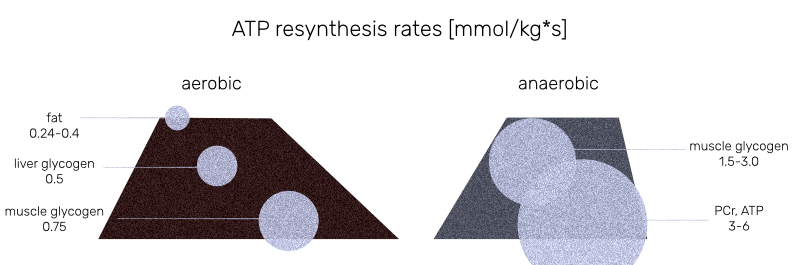
- ATP-resynthesis rate per second is higher for glycogen compared to fatty acids i.e. glycogen delivers energy faster
- On top of that carbs are more O2-efficient i.e. give more energy per litre O2
Mind you that this list is by far not exhaustive. Carbs also play a role in muscular fatigue, recovery, signalling and who knows what else – which are topics we will certainly get back to later in this series. But from these differences alone we can now build an argument for the necessity of carbs during strenuous exercise.
The first bullet point may seem less relevant for longer events which are covered more and more aerobically as the distance grows, however even longer events can and will contain portions that have to be covered anaerobically. This can be the case in undulating terrain on the trails when you want to tackle a short but steep climb or if you are really racing let’s say your 5 or your 10k in the sense that you are competing against others and are employing race tactics: Going over your sustainable race pace for a brief amount to wear your competitors down, close a gap or play mind games. These scenarios represent spikes in energy demand that will require anaerobic oxidization and thus carbs/glucose/glycogen.
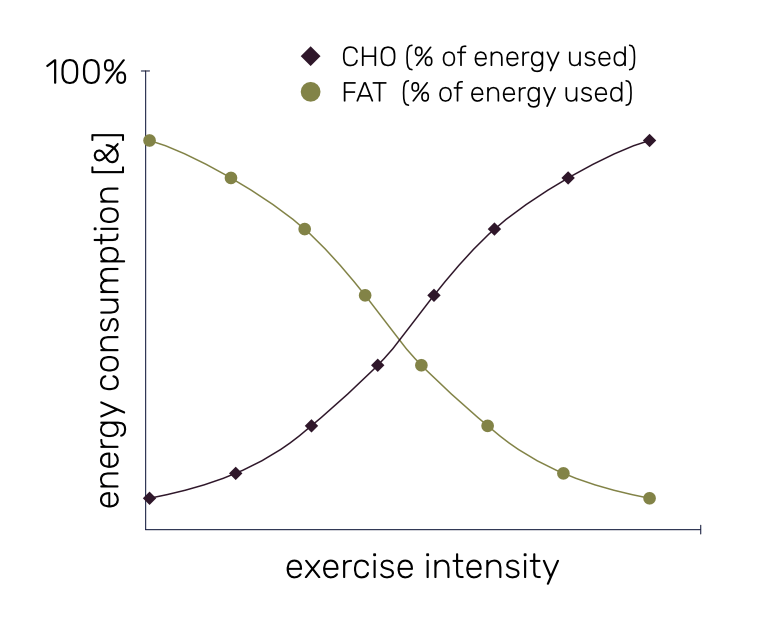
For the second and third point – the higher ATP-resynthesis rate and the O2-efficiency – we can take a look at Figure 1. We see that with growing exercise intensity our bodies energy requirements are covered more and more by carbohydrates. They are just able to do what fat can’t: Cover the energy demands fast enough and while doing so requiring less oxygen. While we oxidize carbs aerobically we need 7 to 8% less oxygen for the same amount of energy compared to fat. That’s huge! And should we exceed the intensity that can be handled aerobically carbs can be oxidized anaerobically which yields an even higher ATP-rate! You can find an overview of the rates in Figure 2.
Okay, so although it would be great if we were able to rely on fat alone, given that we all have plenty on board for even the longest events, we have now established why carbs are not only the preferred substrate when going fast but also the only sufficient one to get the job done. But knowledge about these mechanisms is not new and thus does not explain why high carb gradually became a more prominent topic in the endurance domain during recent years. With the baseline knowledge we established today we will edge closer to the answer of this question in the next article.
Thank you so much for spending your limited time reading this article. I sincerely hope it was worth your time and hope you have a wonderful day!

